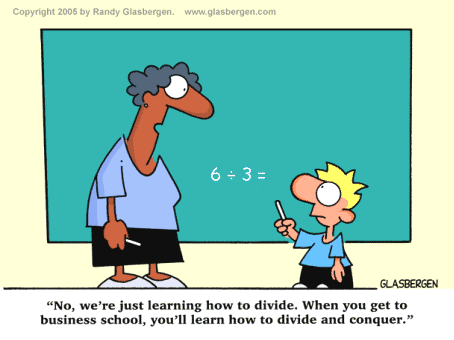
The voices of teachers and students are taken into account far too infrequently when determining how effective the time spent on drilling, pretesting, and taking standardized tests has been to “improve” our public school systems or the experiences of children growing up in them.
Far more frequently the general public is fed agenda-laden opinions of businesspeople and corporations instead. They sell us a side of the story in which our schools are failing, where schools are blamed for economic conditions when they are bad- but do not receive credit when the economy clicks along seamlessly.
I fear that currently our children are subject to too rote work and teaching to the tests because of the pressure to achieve on state mandated tests or face loss of funds, public labeling, and bad press. Our schools are being consumed by these tests under NCLB because of bad policies becoming popular. Why did backwards policies come to power and why do they stay the "norm"? Because they were sold to the public in the prettiest packaging money could buy.
Big business backs politicians and drives legislation. Corporations have an agenda to privatize public schools to get their hands on big chunks of district $$. It is no wonder many of us have never noticed this before, because these exact types of people-businessmen and lawyers- are the individuals in society who make their living by “selling” their side of the story- they are the master spin doctors, and they have a stake in making public schools look bad to further their agendas of doing away with teachers unions and privatizing education.
Corporate businessmen and lawyers come up with buzzwords like "tougher standards" and "back to basics" that sound awesome on the surface and appeal to people’s nostalgia about values and traditions. Unfortunately, catch phrases like this are often wolves in sheep's clothing that conceal huge government mandates manipulated and defined by a dominant elite who simply want to get their hands on power and money, keep the status quo in check, and back their opinions up with numbers.
“Accountability” sounds like a good idea at face value, for example. The trouble comes in when the term needs to be defined with specifics as to WHO is to be held accountable, for doing WHAT, exactly, and where is the money supposed to come from?
If we look at the list of "failing" schools under NCLB's high stakes tests, it reads as a better indicator of the incomes of the parents in town than anything else. As the dominant elite would expect, so the numbers back it up- rich white neighborhood perform the best, and people of color and the poor are concentrated in areas where test scores are low. Are the poor simply stupid and lazy? (I sure hope not!) Another alternative is that the tests aren't testing that they are supposed to, but are biased in favor of of a rich predominantly white dominant elite.
“Accountability” sounds like a good idea at face value, for example. The trouble comes in when the term needs to be defined with specifics as to WHO is to be held accountable, for doing WHAT, exactly, and where is the money supposed to come from?
If we look at the list of "failing" schools under NCLB's high stakes tests, it reads as a better indicator of the incomes of the parents in town than anything else. As the dominant elite would expect, so the numbers back it up- rich white neighborhood perform the best, and people of color and the poor are concentrated in areas where test scores are low. Are the poor simply stupid and lazy? (I sure hope not!) Another alternative is that the tests aren't testing that they are supposed to, but are biased in favor of of a rich predominantly white dominant elite.
posted by Ms. D at
10:21 AM


